
Cover image adapted from Canva template “Blue Yellow Red Fun Illustration Back to School Sale Flyer” by Alma Aurelia. Edited by the author. Used under Canva Content License Agreement.
The first time I saw this word “skibidi” was on a TV show called The Floor. If you don’t know what it is, check this out. Believe it or not, I have picked up a lot of new words from that show, usually ordinary categories like signs, objects, or occasional idiom. So, when a category called “skibidi” suddenly appeared, I was completely lost. What was this? I was questioning whether this is even a word.
Then the players started to answer questions, and familiar words began to show up. “Delulu,” “Trad Wife,” “Rizz.” Those were the terms I recognised, and obviously ones I had learned from the internet. So I assumed “skibidi” must be the same kind of thing too, just another internet slang I somehow missed.

llustration of “Skibidi Toilet” by Di (they-them). Licensed under Creative Commons Zero, Public Domain Dedication (CC0).
Words Without Clear Definitions
Driven by curiosity, I looked up this word straight away. Instead of finding a definition of it, I ran into something way stranger than I thought– “Skibidi Toilet,” along with image after image of a man’s head coming out of a toilet. I dug into it and realised that this word did not really have one strict meaning at all. Merriam Webster describes it as a “gibberish word spread by Skibidi Toilet,” while Cambridge says it can mean things like “cool” or “bad”, or simply be used as a joke with no clear meaning at all. In other words, it works as a word without a neat definition.
That is what makes it interesting. “Skibidi” is not just one weird internet word. It points to a new kind of online language that often doesn’t look like normal language. Some of these expressions are fairly easy to explain. “Delulu,” for example, is obviously connected to the word “delusional.” Even though the form of “rizz” looks a bit stange, it still seems like a word and actually means something. But some expressions are just much looser. Terms like “jittleyang” or “fuhuhluhtoogan” are not only hard to recognise, but also do not carry a clear meaning. They work less like vocabulary and more like a signal. If you already know the culture around them, they make sense. If you do not, they just sound ridiculous. And maybe that is part of the point.
From Internet Slang to Word of the Year
However, these very online words no longer stay inside their small internet circles. They spread far beyond the people who first used them and some become mainstream enough to enter dictionaries or even become Word of the Year. Yes, that Word of the Year. Oxford’s recent selections make that pretty obvious: “goblin mode” in 2022, “rizz” in 2023, “brain rot” in 2024, and “rage bait” in 2025. All these words come directly out of internet culture.
And the line can be pushed even further, Dictionary.com’s Word of the Year for 2025 was “67,” which is not even a word. Their lexicographers said searches for 67 rose more than sixfold from June 2025 and showed no signs of stopping, while other two-digit numbers showed no meaningful trend. You must have heard “67” at least once by now. Ngl, it’s hard to avoid. At this point, these are no longer just online jokes. They spread so far that dictionaries start recording them, and institutions begin treating them as culturally important.
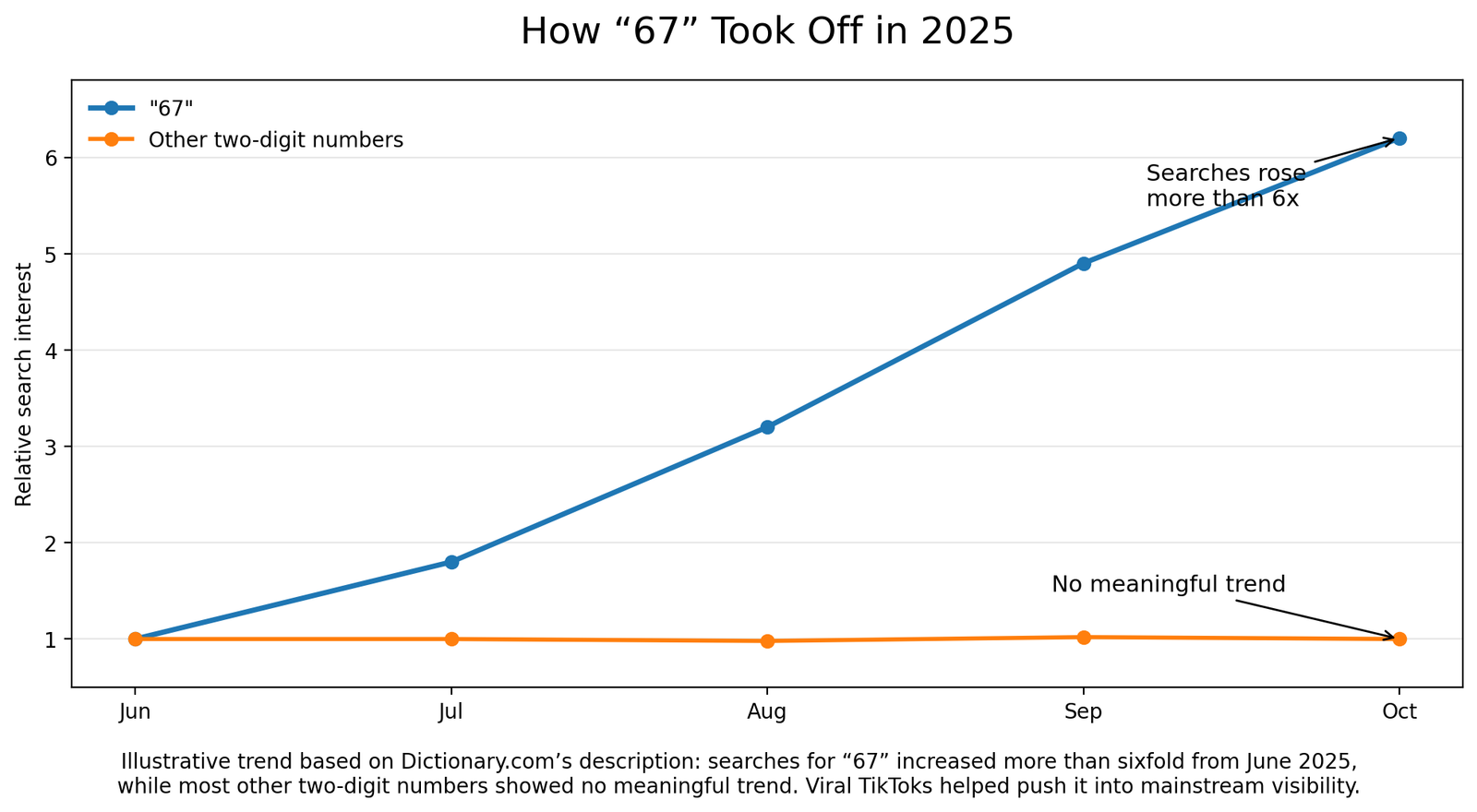
Chart created by the author to illustrate the rise of “67” searches in 2025.
When Repetition Replaces Meaning
Part of what makes these expressions impossible to ignore is not just who says them, but how often the internet makes them appear and appear again. Dictionary.com also linked the spread of 67 to viral TikToks and online repetition. Online users may pick those words up first, but the platforms do the rest. Viral TikToks, comment sections, meme pages, reels and shorts all encourage repetition. A word does not have to be fully understood to become unavoidable online. It only has to appear enough times, in enough places, until familiarity starts doing the work that meaning used to do.
Does It Really Matter?
So maybe the real point is not whether “skibidi” is a proper word. It is that online culture now has the power to make almost anything function like one. A weird sound, a nonsense joke, a meaningless phrase, even a number can spread far enough to become part of everyday language. That says, what counts as a word, and what counts as meaningful language, now feels much looser than it used to.